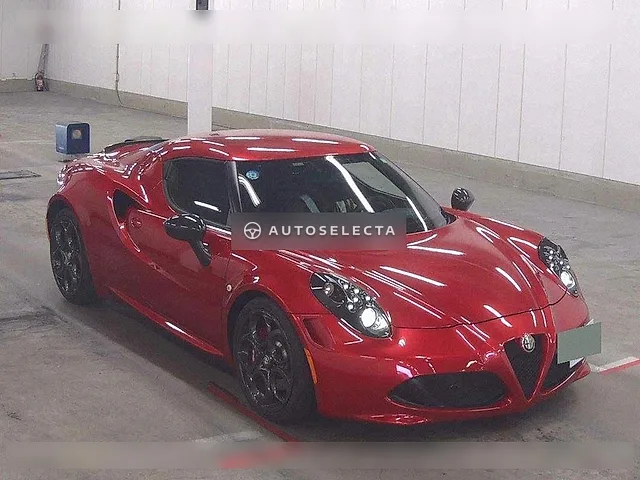








Overview of the Alfa Romeo 4C
This 2020 Alfa Romeo 4C is a genuinely rare thing to find coming out of a Japanese auction house: a right hand drive example of Alfa Romeo's carbon tubbed mid engine sports car, finished in black and dressed with a striking TEZZO carbon GT wing. Chassis code 96018 identifies it as the 4C proper, powered by the 1.8 litre turbocharged four cylinder engine mated to the six speed TCT dual clutch transmission, described on the auction sheet as floor automatic (FAT). The car shows 34,628 km on the odometer, which converts to approximately 21,522 miles, and it carries a grade 4 overall auction score with an interior grade of B from USS Nagoya, one of Japan's most respected auction venues.
What makes this particular 4C stand out is the specification. Alongside the factory carbon fibre monocoque construction that defines the model, this car has been finished with an aftermarket TEZZO carbon GT wing, aftermarket exhaust tips, aftermarket alloy wheels, a digital rear view mirror and what the auction sheet describes as coilover suspension, though this last point is not stated with full certainty by the inspector. Inside, Recaro seats are noted, again flagged by the inspector as not entirely certain, along with paddle shifters and carbon trim to the A pillars and handbrake surround. This is a 4C that has clearly been built up by a previous owner into something closer to a track focused specification, while retaining its road legal status and dealer sold history.
Bidding on this Alfa Romeo 4C opens at ¥4,000,000 at the USS Nagoya and Hokuriku sale on 2 October 2026. Similar 4C examples sold at Japanese auction recently have made between £23,446 and £33,247, though that range reflects other cars in different specifications and conditions rather than a guarantee for this particular vehicle. The current pricing detail for this lot, including live currency conversion and estimated landed cost, is shown in the price panel on this page and updates in real time, so please refer there rather than to any figure quoted elsewhere.
The Drive Review
The Alfa Romeo 4C is unlike almost anything else built in the last fifteen years, and that is precisely why it has developed such a devoted following among enthusiasts. Its carbon fibre passenger cell, a genuine first for a series production car at this price point when launched, is wrapped in aluminium subframes front and rear and skinned in lightweight composite bodywork. The result is a kerb weight that undercuts almost every rival on sale at the time, and that weight saving defines everything about how the car drives.
Power comes from Alfa Romeo's 1750 TBi, a 1.8 litre turbocharged four cylinder producing 240 PS in its standard European tune, sent exclusively to the rear wheels through a six speed TCT dual clutch gearbox with paddle shifters, exactly as fitted to this example. There is no power steering assistance on the 4C, a deliberate decision by Alfa's engineers to keep the driver connected to the front tyres, and it is one of the most talked about characteristics of the car. At low speed it demands real effort, particularly when parking, but once moving the unassisted rack delivers a purity of feedback that later, heavier and more insulated performance cars simply cannot match.
The mid engine, rear drive layout combined with the extremely low weight makes the 4C feel alive in a way few modern cars do. Turn in is immediate, the chassis balance is neutral to the point of feeling almost like a mid engine race car, and the turbocharged four cylinder, while not the most tuneful unit Alfa has built, delivers strong mid range punch and a raspy, purposeful soundtrack, especially with aftermarket exhaust work such as the tips fitted to this car. The TCT gearbox can feel abrupt at low speed in normal driving, a known trait of the model, but in Dynamic or Race mode with the paddles it shifts crisply and suits the car's aggressive character.
Buyers should understand that the 4C is not a comfortable grand tourer. Ride quality is firm, cabin insulation is minimal, and the ergonomics are unapologetically driver focused rather than luxurious. This is a car built for engagement over comfort, closer in spirit to a road going track car than a typical modern sports coupe, and that is exactly the appeal for the enthusiasts who seek one out.
Auction Details
This Alfa Romeo 4C is being offered through USS Nagoya and Hokuriku, one of Japan's established auction venues, under lot number 20173. The auction is scheduled for 2 October 2026, with all bids needing to be submitted before 9PM UK time on the evening before auction, meaning Thursday 1 October. The car carries an overall auction grade of 4 with an interior grade of B, and the auction start price is set at ¥4,000,000. As noted above, two similar Alfa Romeo 4C examples have sold at Japanese auction recently for between £23,446 and £33,247, though this reflects the wider market for the model at auction rather than a projection for this specific car. No Autoselecta guide bidding range has been set for this lot at the time of writing, so bidders should use the live price panel on this page for up to date estimated bidding and cost information.
Vehicle Specifications
Manufacturer: Alfa Romeo. Model: 4C. Chassis code: 96018. First registration: Reiwa 2, which is 2020, month not recorded on the auction sheet. Engine capacity: 1,800 cc. Transmission: six speed TCT dual clutch automatic (noted as floor automatic, FAT, on the sheet). Drive layout: not marked on the auction sheet, though the 4C is factory built as rear wheel drive. Exterior colour: black, recorded as the car's original factory colour with no colour change. Fuel type: petrol. Steering position: right hand drive. Seating capacity: two seats. Odometer reading: 34,628 km, approximately 21,522 miles. Frame number is recorded as ZAR96000000M384229, though the auction sheet itself flags this reading as not fully certain regarding the exact number of zeros.
Factory Features and Equipment
The auction sheet confirms power windows (PW) as fitted equipment, along with air conditioning marked as AC. A new car service book with an accompanying warranty booklet is present, and this booklet carries a dealer's stamp, confirming the car's history through an authorised dealer network at some point in its life. Beyond these confirmed items, the auction sheet does not detail further factory options, and nothing else regarding original equipment is confirmed in the data provided.
Japanese Auction Report Translation
The auction sheet has been translated and checked by Autoselecta. It records the lot as number 20173, sitting within the imported car section (輸入車コーナー) of the sale. First registration is given as Reiwa 2, equivalent to 2020, with the month left blank. The model is recorded as Alfa Romeo 4C, with the grade field left blank. Engine capacity is 1800 cc and the chassis code is given as 96018. Neither 2WD nor 4WD is marked on the sheet. The overall auction grade is 4, with an interior grade of B. The vehicle inspection (shaken) expiry field is blank. The odometer reads 34,628 km, with the kilometre marking circled to confirm it as genuine kilometres rather than miles. The transmission is marked as floor automatic (FAT). Air conditioning is marked as fitted (AC). The exterior colour is recorded as black, described as the original factory colour with no repaint or colour change noted, though the specific paint colour code is not written on the sheet. Fuel is circled as petrol. The new car service book, together with its accompanying warranty booklet, is marked as present. The import classification is circled as parallel import (並行). Steering is confirmed as right hand (右). A recycling deposit of 11,370 yen is noted, which is standard practice on Japanese vehicle sales. Seating capacity is listed as two. The frame number is given as ZAR96000000M384229, though the sheet itself flags this reading as uncertain in terms of the exact digit count.
Under equipment, power windows (PW) are marked. Under sales points, the inspector lists a TEZZO carbon GT wing, aftermarket exhaust tips, what is read as coilover suspension together with Recaro seats (flagged by the inspector as not entirely certain), and aftermarket alloy wheels together with a digital rear view mirror.
Under points to note, the sheet records paddle shifters along with carbon trim to the A pillars and handbrake. It states that the car was originally sold through a dealer, but because the caution or identification plate had become scratched, the chassis number has since been re stamped, meaning the car must now be treated and declared as a parallel import. The sheet separately confirms that a warranty booklet bearing a dealer's stamp is present.
Under the inspector's report, the following faults are noted directly: scratched trim, scratched wheels, stone chip scratches to the lower exterior bodywork (with a bracketed word that could not be read with full confidence, possibly indicating a wave or dent but not certain), and small scratches generally. These comments should be read alongside the damage diagram below for exact locations.
Damage Diagram and Body Condition
The damage diagram on the auction sheet marks the front bumper with a combination of stone chip damage and scratching, along with rub marks accompanied by scratches, indicating the kind of wear typically picked up from road use and stone impact at the front of the car. The bonnet carries a scratch mark, though the sheet does not specify its size. A further stone chip and scratch mark is noted in the area of the front windscreen surround, though the inspector's own notes flag this exact location as not entirely certain.
Taken together with the inspector's written comments of scratched trim, scratched wheels, stone chip marks to the lower body and general small scratches, this points to a car that presents as a genuine, lived with example rather than a garage queen. There is no mention anywhere on the sheet of dents, creases, rust, corrosion, panel replacement or repaint work beyond the noted scratches and stone chips, and no W codes, U codes or XX replaced panel markings appear on the sheet as translated. On the balance of what is recorded, this 4C sits as a usable enthusiast condition car, showing typical cosmetic wear consistent with its mileage and history, with an overall auction grade of 4 reflecting a solid, honest example rather than a concours standard car.
From the photographs provided, the black paintwork presents with strong gloss and reflection across the bonnet, roof and rear quarters, and the fitted TEZZO carbon GT wing, aftermarket alloy wheels and lower front splitter are all clearly visible and consistent with the sales points noted on the sheet. No obvious accident damage, misaligned panels or paint mismatch is visible in the images supplied, though buyers should rely on the auction sheet's documented condition points above rather than photographs alone when assessing exact cosmetic condition.
Interior Condition
The interior of this Alfa Romeo 4C carries an inspector graded interior score of B, which on the standard Japanese auction interior scale indicates a cabin with light wear consistent with genuine use, but nothing approaching heavy damage or excessive deterioration. The auction sheet's inspector report notes trim scratched as a specific point, which buyers should note alongside the interior grade.
From the photographs, the cabin shows a driver focused layout with a flat bottomed steering wheel carrying red accent stitching and a carbon effect insert, paddle shifters mounted behind the wheel, a digital instrument cluster displaying a neutral gear indicator and warning lamps illuminated as is typical during auction house photography of a stationary vehicle, and visible carbon fibre trim to the door sill area consistent with the auction sheet's note of carbon A pillar and handbrake trim. A Recaro branded seat cover is visible in one interior photograph, supporting the sales point note regarding Recaro seats, though the inspector themselves flagged this detail as not entirely certain on the sheet. The gear selector area shows a carbon effect surround and what appears to be an aftermarket handbrake lever finish. Factory air conditioning controls and power window switches are visible on the dashboard and door area, consistent with the AC and PW markings on the auction sheet.
Japanese Auction Grades
Japanese auction grades offer a standardised, independent snapshot of a car's condition at the point of inspection, and understanding them is essential when buying unseen from Japan. An overall grade of 4, as given to this Alfa Romeo 4C, generally indicates a good, solid used car with some visible wear and minor cosmetic imperfections, but no accident history or structural damage recorded. This sits below a 4.5 or 5, which would suggest a cleaner, closer to showroom example, but comfortably above a 3, which would indicate a more heavily used or worn car. The separate interior grade, given here as B, specifically addresses cabin condition, and a B grade indicates light wear such as minor scuffing or scratching, again consistent with the trim scratched note recorded by the inspector. These grades are assigned by trained, independent auction house inspectors and are widely trusted across the Japanese used car export trade, though they remain a condition guide rather than a mechanical warranty.
Model History
The Alfa Romeo 4C was launched in 2013 as Alfa's return to the true sports car segment, built around a carbon fibre passenger tub, a construction technique previously reserved for cars costing several times its price. Developed with input from Alfa's motorsport heritage and built at the Maserati factory in Modena, the 4C paired that exotic carbon monocoque with aluminium front and rear subframes and a transversely mounted 1.8 litre turbocharged four cylinder engine, the same 1750 TBi unit found in various Alfa and Giulietta applications but reworked for mid engine, rear drive use. The 4C was offered in coupe form and later as the 4C Spider with a lightweight removable roof. Production continued through to 2020, by which point the model had become something of a swansong for Alfa's more analogue, driver focused era before the brand's move toward larger, more mainstream models. This 2020 example, being one of the final cars built before production ended, represents one of the last true Alfa Romeo 4Cs to leave the factory.
Why This Model Has Become Collectible
The Alfa Romeo 4C occupies a genuinely unusual position in the collector market. It was the first series production road car at its price point to use a full carbon fibre passenger monocoque, a technique borrowed from Formula One and hypercar construction, and that engineering alone has cemented its reputation among enthusiasts and collectors who understand what went into building it. Production numbers were always modest compared to mainstream sports cars, and with the model now out of production entirely, well kept, unmodified or tastefully specified examples like this one are becoming increasingly difficult to source, particularly in right hand drive form.
The unassisted steering, low weight, and raw mechanical feel place the 4C in a shrinking category of cars built before manufacturers universally adopted heavier assistance systems and greater insulation from the road. That analogue character, combined with genuine motorsport derived construction and the flair of Alfa Romeo's design language, has driven steady global demand for good examples, with buyers across Europe, the Middle East, Australia and Asia all competing for well presented cars. Right hand drive 4C examples such as this one are scarcer still, since the model's largest markets were left hand drive, making genuine right hand drive cars a particular point of interest for UK, Japanese domestic, Australian and other right hand drive market buyers.
What To Look For When Buying This Model
Buyers considering an Alfa Romeo 4C should pay close attention to the condition of the carbon fibre tub itself, since any accident history involving the monocoque can be extremely costly to repair and, in some cases, uneconomical. The TCT dual clutch transmission should be checked for smooth operation at low speed, since abrupt or hesitant shifting at parking speeds is a known trait of the model but should not be excessive. The unassisted steering rack should be checked for consistent weighting without notchiness, and the turbocharged engine should be checked for any signs of oil leaks or unusual noise under load, as with any turbocharged four cylinder of this era. Given this particular car's history, that the caution plate was scratched and the chassis number subsequently re stamped, buyers should also be comfortable with the parallel import classification confirmed on the sheet, and should note the aftermarket coilover suspension, alloy wheels and exhaust modifications when considering originality, since these will affect both the driving character and the car's appeal to buyers who prize factory specification.
Why Import This Car From Japan
Japan remains one of the best sources in the world for well kept, low mileage performance cars, thanks to a domestic culture of meticulous vehicle care, comprehensive service documentation and an auction system that provides independent, standardised condition grading before a car ever changes hands. This Alfa Romeo 4C, despite being an Italian built car, has spent its life in the Japanese market as a parallel import, benefitting from the same careful ownership culture and rigorous auction house inspection that makes Japan such a trusted source for enthusiast vehicles internationally. Sourcing directly from Japanese auction, rather than through a private sale or an already imported example on a domestic market, gives buyers full transparency over the vehicle's documented condition, auction grade and inspector notes before committing to purchase.
Ultimate Guide For Japanese Imports
Importing a car from Japan involves several stages, and understanding the process helps buyers approach it with confidence. The car must first be won at auction, following which export preparation, deregistration from the Japanese register and shipping arrangements are organised. Depending on the destination country, buyers should be aware of local import duty, VAT or equivalent taxes, registration requirements, and any compliance or modification requirements specific to their country, since these vary considerably around the world. Buyers importing into the United Kingdom should be aware of HMRC import duty and VAT requirements alongside DVLA registration, while buyers elsewhere should check their own country's specific import age rules, emissions requirements and registration processes, since these differ significantly by market. Working with an experienced sourcing and shipping partner such as Autoselecta helps buyers navigate each of these steps with clarity from the point of bidding through to the car's arrival in their home country.
Why Import Through Autoselecta
Autoselecta provides direct access to Japan's major auction houses, including USS Nagoya and Hokuriku where this Alfa Romeo 4C is listed, giving buyers worldwide the ability to bid on genuine Japanese auction stock rather than relying on already exported cars with unclear history. Every vehicle report is built around full auction sheet transparency, translating every inspector comment, sales point and damage diagram marking so buyers understand exactly what they are bidding on before committing. Autoselecta's team assists with vehicle sourcing, bidding strategy, export documentation, shipping arrangements and import support in the buyer's own country, with vehicle tracking available where applicable, so buyers are kept informed from the moment a bid is placed through to the car's safe arrival. Communication throughout the process is a core part of Autoselecta's service, ensuring buyers are never left guessing about the status of their purchase.
All bids must be submitted before 9PM UK time the evening before auction.
Browse This Week's Japanese Auctions
Autoselecta lists a constantly updated selection of vehicles direct from Japan's major auction houses each week, giving buyers worldwide the opportunity to review fresh stock, auction grades and detailed sheet translations before bidding opens.
Live Auction Search
Buyers can search live Japanese auction listings through Autoselecta's platform, filtering by manufacturer, model, auction grade, mileage and more, to find the right car ahead of upcoming auction dates.
Auction Caution
All vehicles offered through Japanese auction, including this Alfa Romeo 4C, are inspected by independent auction house staff before sale, but remain used vehicles sold as seen at the point of auction, not new cars carrying a mechanical warranty. The auction sheet, translated in full above, represents an independent condition guide compiled by the auction house inspector, not a guarantee against future mechanical issues. Buyers should bear in mind the specific inspector notes recorded on this car, namely scratched trim, scratched wheels, stone chip damage to the lower exterior bodywork, general small scratches, and the fact that the chassis number has been re stamped following damage to the original caution plate, meaning the car must be treated as a parallel import. Older performance cars, including carbon tubbed models such as the 4C, may require servicing, maintenance or refurbishment after purchase, and buyers should budget accordingly.