



Overview of the Lamborghini Huracan EVO RWD
This Lamborghini Huracan EVO RWD is a left hand drive, dealer imported coupe first registered in December 2020, finished in green and offered at USS Tokyo as lot 65007 on 15 October 2026. The auction sheet shows 16,830 km, approximately 10,458 miles, an overall grade of 5 and an interior grade of A. It is a petrol car with a 5,200 cc engine, chassis code 7BA-ZFDGFB, and the sheet marks it as 2WD.
The EVO RWD is the purist's Huracan. It keeps the naturally aspirated 5.2 litre V10 of the wider family, drops the front driveshafts and sends everything to the rear axle. For a buyer who wants the Huracan engine without the safety net of four wheel drive, this is the version to chase. This one also comes with a service book, a spare key and six dealer inspections recorded on the sheet.
The Drive Review
The heart of the Huracan EVO RWD is the 5.2 litre V10, rated at 610 PS and 560 Nm, with a top speed of around 325 km/h and a quoted 0 to 100 km/h time of about 3.3 seconds. The numbers matter less than the delivery. There is no turbocharger, so the throttle response is immediate, and the V10 pulls hard towards a very high rev limit with a hard, layered howl that few modern engines can match.
Power goes through a seven speed dual clutch gearbox, which the sheet records as automatic (CAT). In town it can be left to shift for itself, and on a good road the paddles on the steering column give quick, crisp changes. The instrument photograph shows the car in Strada mode, the softest of the drive settings, with Sport and Corsa available for sharper responses.
Because only the rear wheels are driven, the car feels lighter and more playful than the all wheel drive Huracan. The steering is quick, and on this car it is the Lamborghini Dynamic Steering system, which varies its ratio with speed. Lamborghini tuned the RWD model with its own traction control calibration, so the rear tyres can slide progressively rather than abruptly. It is a mid engined supercar that rewards commitment, yet it remains easy to drive at a gentle pace.
Auction Details
The car is lot 65007 at USS Tokyo, auction date 15 October 2026 in Japan. The grade is 5 overall and A for the interior. The exterior grade in the feed is also 5. The inspection (shaken) is valid until 14 December 2027. The auction start price is ¥18,990,000.
The Autoselecta guide bidding range for this car is £119,500 to £143,750. That is an estimated range based on similar cars sold at Japanese auctions, whose results sit between roughly £119,500 and £143,600. It is not a guaranteed purchase price and the car may sell above or below it. For the minimum bid and the landed cost to your country, please use the price panel on this page, which is calculated live.
All bids must be submitted before 9PM UK time the evening before auction.
Vehicle Specifications
Manufacturer: Lamborghini. Model: Huracan, grade EVO RWD, coupe body. Chassis code 7BA-ZFDGFB. First registration December 2020 (Reiwa 2). Engine capacity 5,200 cc, petrol. Transmission recorded as CAT automatic. Drive 2WD, which matches the rear wheel drive layout of the EVO RWD. Left hand steering. Seating for two.
The sheet gives the exterior as original green, with the body colour named as Verde Selvans. The colour code box is blank, and the colour change column holds only an arrow, which reads as no colour change recorded. The interior is black tones. Sheet dimensions are 452 cm long, 193 cm wide and 116 cm high. Odometer 16,830 km (about 10,458 miles). The instrument cluster in the photograph reads 16,827 km, which is consistent with the sheet. The import model year box is blank, and the recycling deposit is shown as ¥12,720.
Factory Features and Equipment
The sheet marks genuine alloy wheels, power steering, power windows, leather, navigation and airbags, plus automatic air conditioning. The sales points add a long list of specification highlights: Lifestyle and Driver Pack for Coupe, Aesir 20 inch diamond cut wheels with package, red brake calipers, Style Package in High Gloss Black, Lamborghini Dynamic Steering and the Ambient Light Package.
The points to note add a multifunction steering wheel in Alcantara, fully electrically adjustable and heated seats, smartphone interface with connected services, and an embroidered Lamborghini shield on the headrests. The photographs show the diamond cut wheels with red calipers, a black roof and engine cover section with louvres, an Alcantara steering wheel with paddles, a portrait centre touchscreen and a row of toggle switches. Whether the brakes are steel or carbon ceramic is not confirmed on the sheet. The sheet does not mention a spare wheel, and the spare tyre circle on the diagram is unmarked.
Japanese Auction Report Translation
This report was translated and checked by Autoselecta. The sheet shows lot 65007, first registration December 2020, Lamborghini Huracan, grade EVO RWD, type 7BA-ZFDGFB, 5200 cc, coupe body, 2WD, grade 5, interior A, odometer 16,830 km, automatic air conditioning, petrol, steering left, dealer import, two seats and a Nerima registration plate. The shaken runs until 14 December 2027.
The new car service book with warranty card is marked present. The sales points say the car was bought in directly from the private owner and that a spare key is present. The service records list dealer inspections in October 2021 at 1,881 km, December 2022 at 8,025 km, April 2023 at 8,641 km, December 2023 at 9,824 km, September 2025 at 10,456 km and December 2025 at 12,638 km.
The inspector's report is short: half leather, small scuffs on the seat, protective film applied to part of the exterior, and small scratches. No engine, gearbox, oil leak, warning light, air conditioning, electrical, suspension or underbody faults are written. The sheet also does not mention owner manuals, so those are not confirmed. Transfer documents expiry, load capacity, serial number and vehicle usage history are blank.
Damage Diagram and Body Condition
The diagram is light. The front bumper carries a scuff marked A, which is a scratch grade mark. The front of the cabin outline carries a stone chip mark, トビ A, and we cannot be certain whether that refers to the windscreen or the front of the roof. The left side carries a mark for many scratches, with the leader line pointing to the sill or door area, and the right side carries the same many scratches mark with an A1, meaning a small scratch, in the same area. The exact panel on each side is not certain. The rear bumper carries a single A, a scratch.
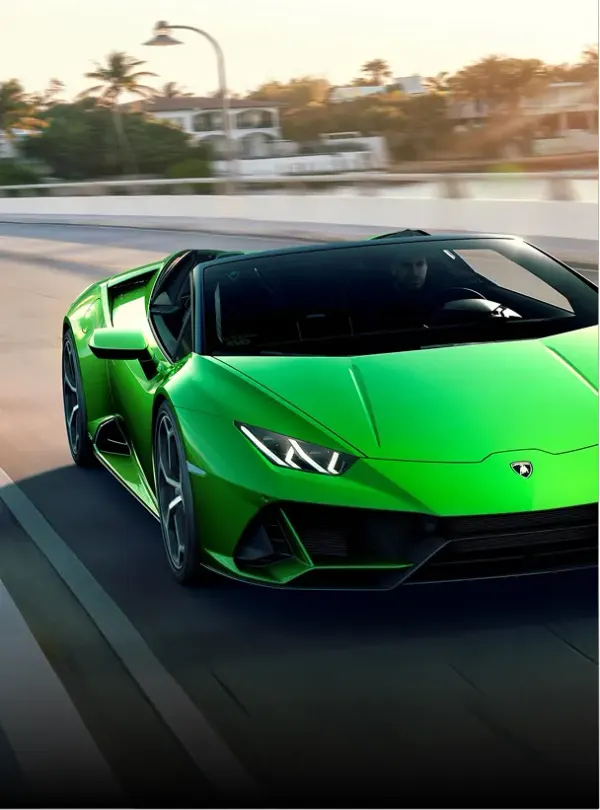
There are no dent, repair, repaint, replaced panel, rust or corrosion marks on the diagram. The inspector also notes protective film on part of the exterior, which can hide or protect marks, so it is worth asking for close photographs. The photographs show a glossy, clean looking green body with no obvious damage. My overall view is that this is a usable, well kept car that is close to collector grade, with the usual light marks of a supercar that has been driven and parked.
Interior Condition
The interior grade is A, the top grade, and the inspector notes only half leather and small scuffs on the seat. The photograph shows black Alcantara seat centres with red stitching, an Alcantara covered armrest, green edged floor mats, the portrait touchscreen and the red toggle switch row. The seat bolster damage, if any, is limited to the small scuffs noted. The cluster photograph shows 016827 km, Strada mode, a fuel level of about 50 per cent and an indicated range of 550 km. A red warning symbol is visible in the lower right of the cluster photograph, but the sheet does not describe it, so it is not confirmed what it relates to. Smell, headlining condition and glass are not mentioned on the sheet.
Japanese Auction Grades
Grade 5 is one of the highest scores on the auction scale, meaning very good condition with only minor marks. Interior grade A is the best interior mark. Together they describe a car in excellent order, with the details above showing what the inspector actually found.
Model History of the Lamborghini Huracan
The Huracan arrived in 2014 as the replacement for the Gallardo, and it was built alongside Audi's R8 development. Its V10 and the dual clutch gearbox were carried through the life of the car. The Huracan EVO came in 2019 with more power, improved aerodynamics and the integrated vehicle dynamics control system. The rear wheel drive EVO RWD followed in 2020, bringing back the lighter, more tail happy character of the original rear wheel drive Huracan LP580-2. Lamborghini later brought the V10 line to a close with the STO, Tecnica and Sterrato derivatives.
Why This Lamborghini Huracan EVO RWD Has Become Collectible
Enthusiasts regard the EVO RWD as the last and best natural expression of the modern V10 supercar. The naturally aspirated engine is a dying breed, and Lamborghini's move to hybrid power for its successor, the Temerario, makes the pure V10 era look more special. The rear wheel drive layout is rarer than the all wheel drive car and sells to those who want driver involvement over outright traction.
This example has appeal beyond its drivetrain. The green Verde Selvans paint, black high gloss styling pack and red calipers give it a striking look. Low mileage of about 10,458 miles, a complete service book, a spare key and a full dealer service record are what buyers look for. Japanese cars also tend to have careful ownership and low annual use. Of course, future values cannot be guaranteed and this should not be treated as an investment.
What To Look For When Buying This Model
Start with the front. Low supercars scrape splitters, and this car has a scuff on the front bumper and protective film on part of the exterior, so ask for photographs of the splitter lip, the underside of the front end and the lower edges of the film. The Aesir diamond cut wheels should also be inspected closely for kerb marks, because the finish is expensive to repair.
The dual clutch gearbox deserves attention. Slow speed manoeuvring puts load on the clutches, and a long record of town use can bring hesitation at low speeds. The sheet records dealer service stamps through December 2025 and no gearbox fault, but a pre shipment inspection and gearbox software check are sensible. Ask for the engine and gearbox service history from the service book.
Finally, check the screen and electronics. The connected services and the smartphone interface depend on a network in the destination country, so confirm which functions you will actually be able to use. Because the car has Alcantara surfaces, the wear on the steering wheel rim and seat bolsters, and the seat scuffs noted by the inspector, should be assessed in person or through detailed photographs.
Why Import This Car From Japan
Japanese supercars tend to be low use, serviced at the dealer and stored indoors, and the auction sheet gives an independent record of condition. With a left hand drive dealer import, this car is also straightforward to register in left hand drive markets.
Ultimate Guide For Japanese Imports
Buying at Japanese auction means choosing a car from the sheet and photographs, placing a maximum bid through a specialist, and arranging export, shipping and local registration. Check your own country's age, emissions and safety rules before bidding.
Why Import Through Autoselecta
Autoselecta gives you direct access to Japanese auctions, translated and checked auction sheets, bidding assistance, vehicle sourcing, export handling, shipping, tracking where available, and import support on arrival in your country, with clear communication throughout. We do not promise savings, only transparency at every step.
Browse This Week's Japanese Auctions
This Huracan is one of many performance cars listed each week at Japanese auction. Browse the current selection to compare it with other supercars and exotics.
Live Auction Search
If this is not quite the right car, our live auction search lets you filter Japanese auctions by make, model, grade and budget, so you can follow the Huracan and its rivals as they appear.
Auction Caution
Auction cars are inspected before sale but they are still used vehicles. The auction sheet is an independent condition guide and not a mechanical warranty. A supercar of this type may need servicing, maintenance or refurbishment after purchase. Please bear in mind the inspector's points on this car: small scuffs on the seat, protective film on part of the exterior, small scratches, and the front bumper, rear bumper, side and stone chip marks on the diagram. The red warning symbol visible in the cluster photograph is not explained on the sheet, so ask us before bidding if you want it checked.


