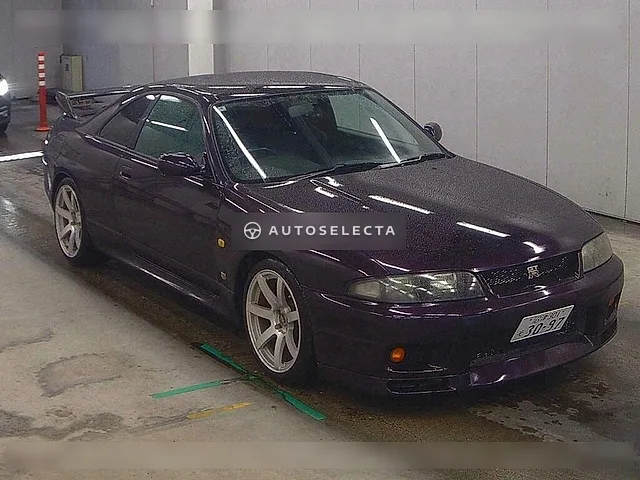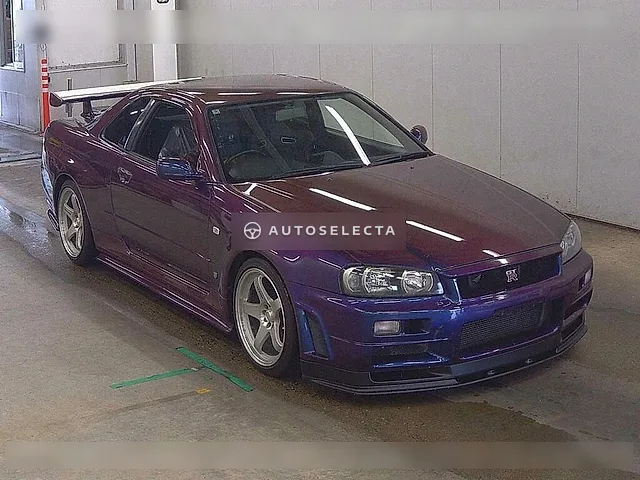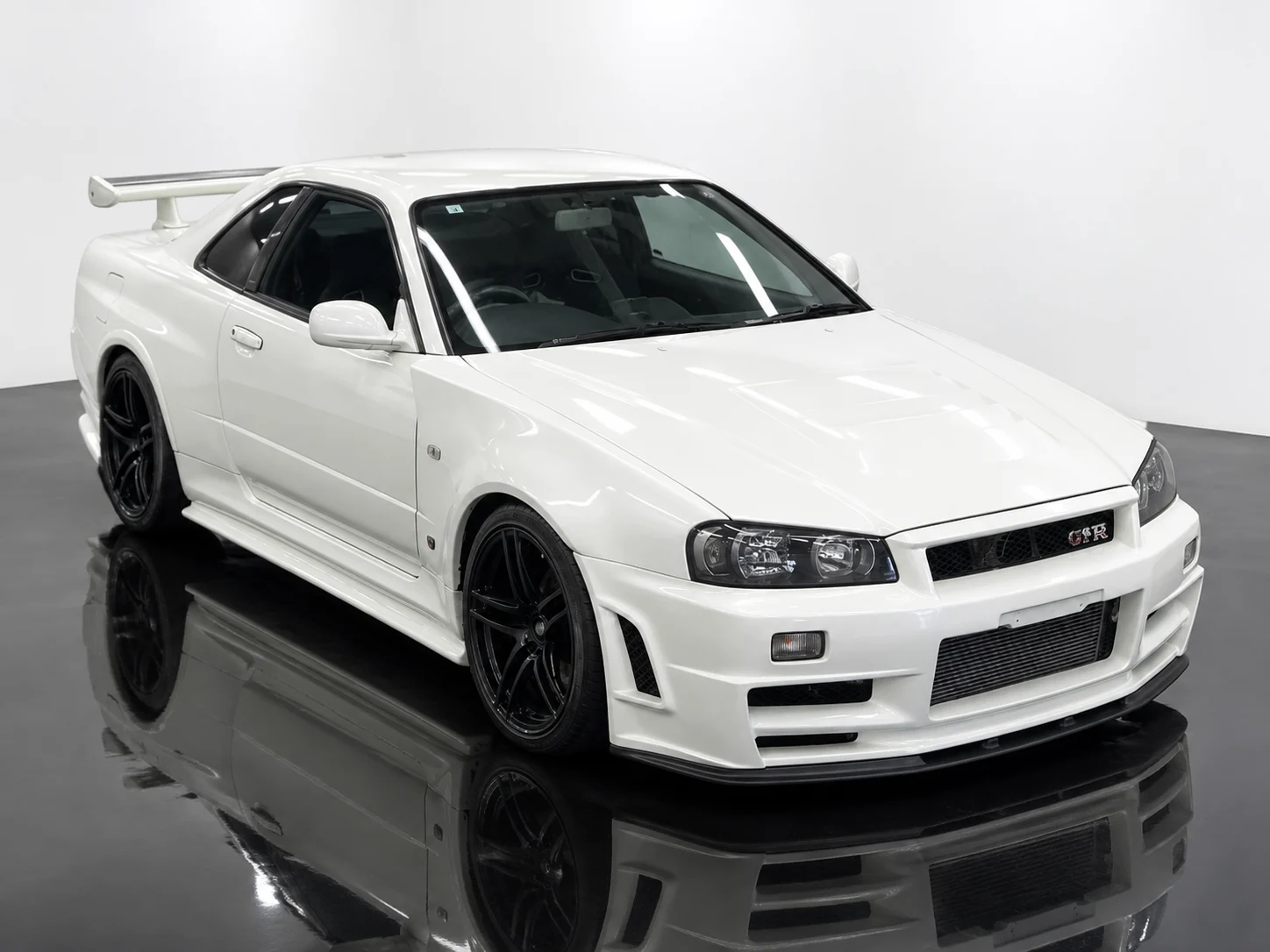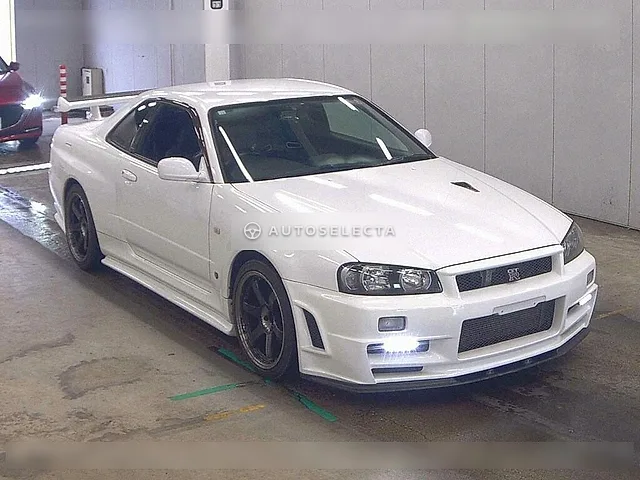


Overview of the Nissan Skyline GT-R BCNR33
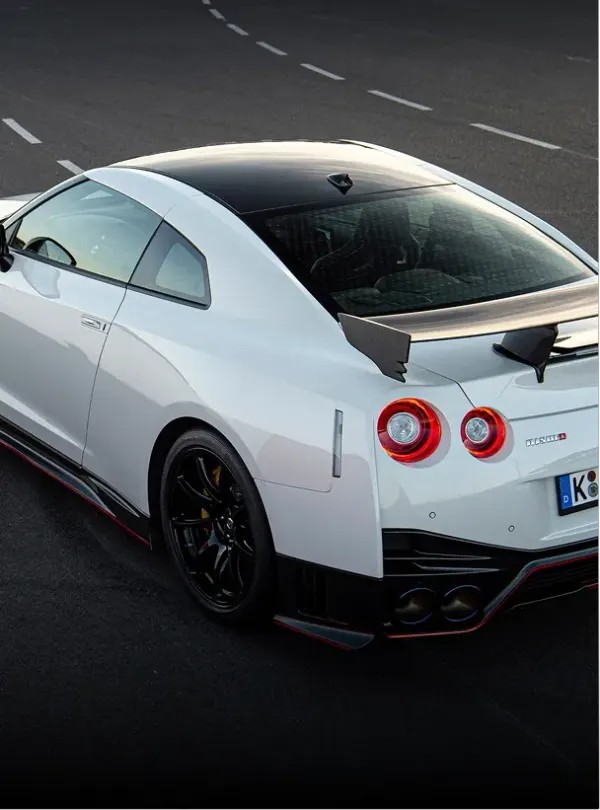
This is a May 1997 Nissan Skyline GT-R, chassis code BCNR33, finished in white over a black interior with an interior grade of B. It is the late model version of the R33 generation GT-R, fitted with the RB26DETT 2.6 litre twin turbo straight six engine, a five speed manual gearbox and Nissan's ATTESA E-TS four wheel drive system. The auction sheet records an odometer reading of 44,716 km, which converts to approximately 27,787 miles, and the auction feed rounds this to 45,000 km or roughly 27,962 miles. The car carries an overall auction grade of 4 at USS Nagoya and Hokuriku, lot number 3095, scheduled for auction on 25 September 2026. This particular BCNR33 has clearly lived a modified life, with a GReddy T78 turbo conversion, an APEXi Power FC engine computer, an aftermarket exhaust system with the catalytic converter removed, coilover suspension and VeilSide wheels, so buyers should approach it as a well specified enthusiast car rather than an unmolested factory example. Every point noted on the auction sheet is translated in full below so bidders can judge the car with complete transparency before committing to a bid on this Nissan Skyline GT-R.
The Drive Review
The BCNR33 GT-R is often considered the most track focused of the three R32, R33 and R34 GT-R generations, and it was the car that famously lapped the Nürburgring Nordschleife in under eight minutes when new, a headline achievement for a Japanese production car in the mid 1990s. The heart of the car is the RB26DETT, a 2.6 litre, twin turbocharged, dual overhead cam straight six that Nissan deliberately under rated on paper to stay within Japan's gentlemen's agreement power limit, and which is well known for its strength and tuning potential well beyond its factory output. In standard form the engine delivers a broad spread of turbocharged torque with a distinctive hard edged induction and turbo whistle, building to a strong top end pull as boost comes in fully. This example has been fitted with a GReddy T78 turbocharger, a larger unit than the factory twin turbo setup, paired with an APEXi Power FC standalone engine management system, a TRUST intercooler and an ARC oil cooler, so the character of this particular car will be noticeably more aggressive in its power delivery and turbo lag than a stock RB26.
The five speed manual gearbox in the BCNR33 has a mechanical, slightly heavy shift action that rewards a deliberate style of driving rather than fast, light changes, and it suits the torque rich nature of the engine well. The ATTESA E-TS four wheel drive system, working with the Super HICAS rear steering, gives the R33 GT-R a planted, neutral feeling through fast corners that is very different from a simple rear wheel drive coupe of the same era, with grip levels that still feel high by modern standards despite the car's age. Steering feel is meatier and less filtered than in a modern electric power steering car, and the whole package feels dense and mechanical, with a kerb weight that is noticeably higher than the earlier R32 GT-R, giving the R33 a slightly more grand touring feel at speed while still being capable of serious pace when driven hard. Weak points known across the model include failure of the electric folding mirror motors, gearbox synchro wear on hard used examples, coolant and turbo related leaks if not maintained, and the well documented reliance on the RB26's oil and coolant systems being kept in good order under high boost. On a modified car such as this, with a larger turbo and standalone management, the driving experience will lean further towards a fast road and occasional track car than a gentle cruiser, and buyers should factor in the more highly strung nature of the drivetrain.
Auction Details
This Nissan Skyline GT-R BCNR33 is being offered through USS Nagoya and Hokuriku, one of Japan's established auction venues, under lot number 3095, with the auction taking place on 25 September 2026. The auction start price is set at 5,980,000 Japanese yen. Autoselecta's minimum bid on this car, the lowest maximum bid Autoselecta will place on behalf of a client, is set at 28,750 pounds; this is a floor figure rather than an estimate of the likely hammer price. There is no Autoselecta guide bidding range set for this particular car, so none is stated or implied here. For context only, twelve broadly similar Skyline GT-R examples sold at Japanese auction have made between 17,409 pounds and 187,828 pounds, with a typical result around 36,297 pounds, though this range spans different generations, specifications and conditions and is not a prediction for this specific car. All bids must be submitted before 9PM UK time the evening before auction.
Vehicle Specifications
The vehicle is a Nissan Skyline GT-R, chassis and model code BCNR33, using the factory type designation E-BCNR33. It was first registered in May 1997 (Heisei year 9). The engine is the 2,600 cc RB26DETT twin turbo straight six, running through a five speed manual transmission (Nissan's F5 code on the auction sheet) and Nissan's ATTESA E-TS four wheel drive system, confirmed on the auction sheet by the circled 4WD marking. The exterior colour is white, factory colour code QM1, with no colour change noted. The interior is trimmed in black with an interior condition grade of B. Seating capacity is listed as four. The frame number recorded on the auction sheet is 041493. Fuel type is petrol, and the car is fitted with automatic air conditioning (AAC on the auction sheet). The odometer reads 44,716 km, equivalent to approximately 27,787 miles; the auction feed rounds this to 45,000 km, or approximately 27,962 miles. The auction sheet does not clearly indicate whether the odometer display is in kilometres or miles, though kilometres is by far the most likely reading for a Japanese domestic market car of this type.
Factory Features and Equipment
The auction sheet confirms power steering, power windows and a driver's airbag as fitted equipment. The car is also noted with automatic air conditioning. Sales points recorded by the inspector highlight that the car has had one owner from new. The auction sheet does not indicate whether a service book, spare key or owner's manuals accompany the car, since the relevant box on the service book section has neither option circled, and no keys or documentation are mentioned elsewhere on the sheet; buyers should treat this as not confirmed rather than assume any of these items are present. A spare wheel symbol is shown as a dotted circle in the bottom right of the diagram, which typically denotes a space saver or temporary spare rather than a full size wheel, though this is not stated explicitly.
Japanese Auction Report Translation
The auction sheet for this Nissan Skyline GT-R has been fully translated by Autoselecta staff. The lot is listed under the Green Corner heading, lot number 3095. First registration is recorded as year 9, May, which corresponds to May 1997 under the Japanese Heisei calendar. Engine capacity is listed as 2600 cc and the chassis code is given as E-BCNR33, with the model named as Skyline GT-R, body style two door coupe. The grade description reads T78 turbine, late model, 4WD, confirming both the turbocharger modification and the drivetrain layout, with the 4WD box circled on the sheet. The overall auction grade is 4, with an interior grade of B. The shaken (Japanese roadworthiness certificate) expiry date field has been left blank on the sheet. Mileage is recorded as 44,716, though the choice between kilometres and miles is not clearly circled. The transmission is listed as F5, a five speed floor mounted manual gearbox, and the air conditioning is listed as AAC, automatic air conditioning. The original colour is confirmed as white with an arrow indicating no repaint or colour change, colour code QM1. Fuel type petrol is circled. The import vehicle section, covering dealer or parallel import status and left or right hand drive, has nothing marked, which is normal for a domestic Japanese market car. Seating capacity is listed as four persons, and the frame number is given as 041493.
Equipment marked on the sheet includes power steering, power windows and an airbag. Under sales points the inspector notes that the car is a one owner vehicle from new, fitted with a GReddy T78 turbocharger, an APEXi Power FC engine management computer, an aftermarket aerodynamic body kit including bonnet and rear spoiler, a TRUST intercooler and an ARC oil cooler. Under points to note, the sheet records an aftermarket exhaust manifold, front pipe and dual silencer with the catalytic converter missing, VeilSide 18 inch alloy wheels and coilover suspension, a genuine GT-R key, factory projector xenon headlights, Recaro seats and a blow off valve.
The inspector's separate report notes a fault with the electric folding door mirror, though which side is affected is not specified. The seat edges are noted as worn. An aftermarket gear knob is fitted and the steering wheel is noted as scuffed. Part of the cabin is noted as dirty or stained. The intercooler is noted as scratched and dented. A door mirror is noted as scratched. The underside of the car is noted with rust and scratches. There is a burn hole noted in the carpet. The wheels are noted as scratched and corroded. General small scratches and small dents are noted across the body, and the handbrake lever knob is noted as peeling. There is also a note referring to a polishing special course carried out, with the date partially legible, most likely referring to recent detailing work rather than any repair.
Damage Diagram and Body Condition
Reading the full damage diagram on the auction sheet, a medium scratch coded A2 is marked at one upper corner panel of the car, with a probable small dent, written ambiguously but most likely representing code U1, marked at the opposite upper corner panel. A stone chip mark, coded トビA, is noted on one of the glass areas, most likely the windscreen or rear window, though the orientation of the diagram is not fully certain. A medium scratch coded A2 appears on a door on one side of the car, alongside another probable small dent on the same door. A further probable small dent is marked at the centre of the roof. On the opposite side of the car, a mark most likely corresponding to code AU1, a small scratch that has received a touch up repair, is noted on a door, with a note of trim or cover lifting nearby, likely referring to a sill or side trim panel. Further probable AU1 markings, small scratches with touch up repair, are noted on a lower wing or corner panel near a wheel arch and on the bumper at one end of the car. No codes for heavy dents, cracked panels, rust through panels or replaced body panels appear on the diagram. Combined with the inspector's separate notes of underside rust and scratches, corroded wheels, and various small scratches and dents around the body, this points to a car that has been used and driven rather than kept as a garage queen, consistent with its heavily modified specification. Overall, this BCNR33 presents as a usable enthusiast condition car rather than a concours or collector grade example, with cosmetic wear typical of a Japanese performance car of this age and mileage that has been actively enjoyed and modified rather than preserved in original factory condition.
Interior Condition
The interior has been given a B grade by the auction house, indicating some visible wear consistent with a used performance car rather than a pristine or near new cabin. The inspector's notes back this up, recording worn edges on the seats, an aftermarket gear knob fitted in place of the original, a scuffed steering wheel, a burn hole in the carpet and some staining or dirt in part of the cabin. The seats themselves have been upgraded to Recaro buckets, which are a well regarded aftermarket fitment for this platform and suit the car's performance orientated modifications, though the factory seat surfaces they replaced would not be present. The dashboard, gauge cluster and switchgear appear factory in layout in the photographs, with the original GT-R specific instrument cluster featuring the turbo boost gauge visible, alongside an additional APEXi Power FC Commander display and further auxiliary gauges added to the dashboard, confirming the engine management upgrade referenced on the auction sheet. The handbrake lever knob is noted as peeling. No mention is made on the auction sheet of the presence of a navigation system, and none should be assumed present.
Japanese Auction Grades
Japanese auction grading gives buyers a fast, standardised way of assessing condition before viewing a car in person, and Autoselecta always explains what these figures mean in practice. An overall grade of 4, as given to this Skyline GT-R, indicates a good used car with some visible wear and minor imperfections, generally free from major accident damage or structural repair, but not in showroom or near new condition. Grades run on a scale where 6 and S typically represent the newest, lowest mileage and most unmarked cars, 5 and 4.5 represent excellent condition, 4 represents a solid, honest used car with light wear, 3.5 and 3 indicate more noticeable wear or a higher likelihood of past repairs, and R or A grades indicate the car has had accident repair work carried out. The separate interior grade, given here as B, assesses the condition of the cabin on its own scale, with A representing very clean, B representing minor wear such as light marks, minor scuffing or slight fading, and C, D and below indicating heavier wear, odours, stains or damage. A grade 4 body with a B interior on this GT-R points to a car that has clearly been driven and enjoyed, with cosmetic wear consistent with its use and modifications, rather than a low mileage, unmarked, factory original example.
Model History
The R33 generation Nissan Skyline GT-R was produced from 1995 to 1998, replacing the R32 that had dominated Japanese touring car racing in the late 1980s and early 1990s. The BCNR33 retained the core formula that made the GT-R famous, the RB26DETT twin turbo straight six engine, the ATTESA E-TS four wheel drive system and Super HICAS four wheel steering, but was built on a stiffer, larger bodyshell aimed at improving high speed stability and refinement over its predecessor. Nissan used the R33 GT-R to set a benchmark lap time at the Nürburgring Nordschleife of under eight minutes, a genuinely significant achievement for a production car at the time and one that cemented the model's reputation as a serious performance machine rather than simply a fast looking coupe. Within Japan the GT-R name carried, and still carries, huge cultural weight, tracing back to the original Hakosuka and Kenmeri GT-Rs of the late 1960s and early 1970s and their motorsport dominance, a lineage that the R32, R33 and R34 generations were built to honour and extend. Late model R33 GT-Rs, such as this May 1997 example, benefited from various detail improvements introduced partway through the production run, including revised suspension tuning and other running changes, and are generally regarded among enthusiasts as the most sorted version of the R33.
Why This Model Has Become Collectible
The Nissan Skyline GT-R BCNR33 has become increasingly sought after outside Japan for a combination of reasons. It represents a high point of 1990s Japanese engineering, built without compromise for performance, using a genuinely capable and tunable engine in the RB26DETT, an advanced four wheel drive system, and rear steering technology that was still relatively rare even on exotic cars of the period. Production numbers were always modest compared with mainstream Japanese coupes of the era, and the car was never officially sold new in the United Kingdom or the United States, meaning that every example in either market today has been individually imported, which naturally limits supply. In the United States, the 25 year import rule administered by the National Highway Traffic Safety Administration means that R33 GT-Rs built up to 1998 are gradually becoming eligible for import as they each individually pass the 25 year threshold, and this has driven a marked increase in demand and prices as American enthusiasts who grew up admiring the model through media and gaming finally gain legal access to it. In the UK, cars from Japan are typically imported under standard used vehicle and individual vehicle approval processes rather than any age restricted scheme. The manual gearbox, analogue instrumentation and heavily mechanical driving experience of the GT-R also appeal strongly to enthusiasts who want a genuine involving drive rather than the more isolated feel of modern turbocharged performance cars. As good, honest examples in Japan are used up, exported or scrapped, well documented cars with clear auction history are becoming harder to find, and this is placing increasing pressure on the wider global market for these cars, particularly cars, like this one, with a coherent and well specified modification history rather than a poorly executed one. Autoselecta does not guarantee future values and this car should not be regarded as a financial investment, simply as a genuinely significant piece of Japanese performance car history that continues to grow in demand.
What To Look For When Buying This Model
Buyers considering any BCNR33 GT-R, modified or standard, should pay close attention to the condition of the RB26DETT engine, particularly evidence of correct servicing, coolant condition and any history of overheating, since these engines respond very well to careful maintenance but can suffer if neglected, especially under increased boost from a larger turbo such as the T78 fitted to this car. The gearbox and clutch should be checked for smooth, clean engagement, since hard use or track driving can accelerate wear on the synchros. The ATTESA E-TS four wheel drive system and Super HICAS rear steering are complex systems by the standards of the era, and any warning lights or unusual behaviour should be investigated, though none are noted as active faults on this particular auction sheet. Electric folding mirror faults, as noted on this car, are a known weak point across the model and are generally a straightforward if slightly fiddly repair. Underside rust and corrosion, also noted here, should always be assessed carefully on a car of this age, particularly on cars that have spent time in colder or wetter regions of Japan, and buyers should budget for further inspection or treatment as needed. On modified examples such as this one, with an upgraded turbo, standalone engine management and removed catalytic converter, it is worth understanding that the tuning setup and any supporting fuelling or cooling upgrades will have a significant bearing on both the car's reliability and its character, and a full history of the work carried out, where available, adds real value and reassurance. As with any auction car, the sheet is an independent snapshot at the time of inspection and does not represent a full mechanical inspection or road test.
Why Import This Car From Japan
Japan remains the best source of well kept, low mileage, right hand drive Skyline GT-Rs, largely because the model was never sold new outside Japan and because the domestic market has traditionally valued careful ownership, garage storage and comprehensive service history. The Japanese auction system, with its independent grading and inspection process, gives buyers a level of transparency that is very difficult to find when buying privately or through dealer stock in the UK or the US, since every car carries a documented condition report before it is ever driven by a prospective buyer. Importing directly from Japan through the auction network also opens up a far larger pool of cars than is typically available locally, including specification and modification combinations, like the GReddy turbo and APEXi management fitted to this car, that are rarely seen on cars that have already been imported and resold.
USA Import Information
This Nissan Skyline GT-R BCNR33 was first registered in May 1997, which means it is now over 25 years old and eligible for legal import into the United States under the federal 25 year rule. Autoselecta can arrange shipment of this car from Japan directly to the United States. Buyers in the US are strongly encouraged to contact Autoselecta with their city or ZIP code before placing a bid, so that a full delivered quotation can be prepared covering the expected purchase price, Japan side costs, ocean freight, and customs related charges and requirements specific to the destination state. Autoselecta can calculate all of these costs in advance, though buyers should understand that this does not represent a promise of zero additional charges, since exact duties, state registration requirements and any compliance costs can vary and are ultimately the buyer's responsibility.
Ultimate Guide For Japanese Imports
Buying a car from a Japanese auction for the first time can feel daunting, particularly with a heavily modified, high value performance model such as a Skyline GT-R. The process begins with careful study of the auction sheet and photographs, exactly as set out in this report, followed by a decision on a maximum bid based on the car's condition, specification and the buyer's own budget rather than on emotion. Once a winning bid is secured, the car is paid for and deregistered in Japan, prepared for export, and then shipped, usually by container, to the buyer's destination port, whether that is the UK, the United States, or another market. On arrival, import paperwork, duties and any compliance or registration requirements are handled according to the rules of the destination country, before the car is finally released to its new owner. Throughout this process, clear communication and realistic expectations around condition, since auction sheets describe a car at a single point in time rather than guarantee its future reliability, make a significant difference to a smooth import experience.
Why Import Through Autoselecta
Autoselecta gives buyers direct access to Japan's major auction houses, including USS Nagoya and Hokuriku where this Skyline GT-R is listed, rather than relying on third party stock that has already been marked up. Every auction sheet is translated in full and explained clearly, as with this report, so buyers understand exactly what they are bidding on before committing any money. Autoselecta can source specific cars to a buyer's brief, provide bidding assistance and guidance on realistic maximum bids, and then handle export documentation, shipping logistics and, where available, tracking of the vehicle on its journey. For UK buyers, Autoselecta supports the process through to arrival and registration, and for US buyers, Autoselecta can arrange shipping and prepare delivered cost quotations in advance. Autoselecta does not promise unrealistic savings compared with other import routes, but focuses on transparency, direct auction access and clear communication throughout, from the moment a car like this Nissan Skyline GT-R is shortlisted through to its arrival with the buyer.
Browse This Week's Japanese Auctions
This Nissan Skyline GT-R BCNR33 is one of many performance and classic Japanese vehicles passing through the auction system this week. Buyers interested in similar Skyline GT-R models, or other Japanese performance cars from this era, are encouraged to get in touch with Autoselecta to discuss current auction listings and upcoming lots that may suit their budget and specification requirements.
Live Auction Search
Autoselecta can search live Japanese auction listings on request, covering multiple auction houses across Japan, to help buyers find a Skyline GT-R or comparable model matching their exact requirements for grade, mileage, colour, transmission and specification, rather than relying solely on the cars currently featured.
Auction Caution
This Nissan Skyline GT-R has been inspected by the auction house and assigned condition grades before sale, but it remains a used performance car with a heavily modified specification, and the auction sheet is an independent condition guide rather than a mechanical warranty. Bidders should be aware of the inspector's specific warnings on this car, including a faulty electric folding mirror, worn seat edges, a burn hole in the carpet, staining in part of the cabin, a scratched and dented intercooler, a scratched door mirror, underside rust and scratches, corroded wheels, general small scratches and dents around the body, and a peeling handbrake knob, alongside the removal of the catalytic converter as part of the aftermarket exhaust system. Given the age of the car and the extent of its modifications, buyers should budget for a thorough post purchase inspection and likely servicing or refurbishment work, including checks of the fuelling, cooling and turbo systems given the GReddy T78 conversion, before relying on the car for regular use.