

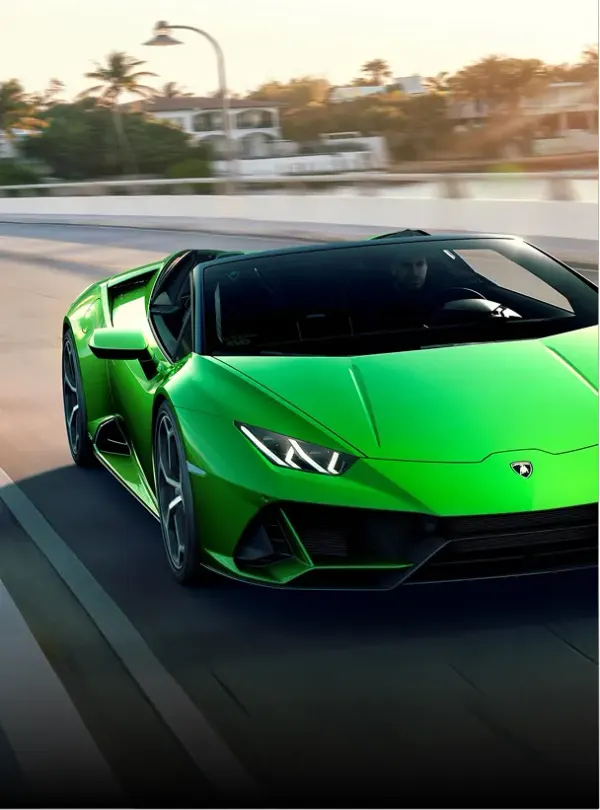




Overview of the Lamborghini Huracan EVO RWD Spyder
This is a 2021 Lamborghini Huracan EVO RWD Spyder, chassis code ZFDGFB, first registered in Japan in August 2021 and offered through USS Kyushu as lot 60002 with an auction grade of 5 and an interior grade of A. The car carries 3,294 on its odometer, a figure the auction sheet records without a clear kilometre or mile marking, though the instrument cluster photograph and the car's near new presentation strongly suggest this is kilometres, equivalent to approximately 2,047 miles. This is an exceptionally low distance for a Huracan of this age and points to a car that has been used sparingly since new.
Finished in Ad Personam Bianco Canopus, a matte white paint applied through Lamborghini's bespoke Ad Personam personalisation programme, the car presents in right hand drive, imported new to Japan through an official dealer channel rather than grey imported, which is an important distinction for buyers who want full factory traceability. The Huracan EVO RWD Spyder is the open top, rear wheel drive variant of Lamborghini's naturally aspirated V10 supercar, built to deliver a more analogue and tail happy driving experience than the four wheel drive EVO, and finished here with a strong specification of carbon ceramic brakes, magnetorheological suspension, forged 20 inch wheels and a full leather interior with coloured stitching. For buyers searching specifically for a Lamborghini Huracan EVO RWD Spyder with genuinely low mileage and a documented Japanese ownership history, this is a rare opportunity.
The Drive Review
The Huracan EVO RWD Spyder is built around Lamborghini's 5.2 litre naturally aspirated V10, a direct descendant of the engine first seen in the Gallardo and refined continually since. In EVO form this unit produces a well known figure in the region of 610 PS, sent exclusively to the rear wheels through a seven speed dual clutch automated gearbox. Removing the front axle compared to the standard all wheel drive EVO changes the character of the car significantly. The nose is lighter, the steering feels more alive and the rear end, especially with the roof down and the soundtrack unfiltered, demands more respect and rewards a more deliberate, old fashioned approach to throttle application through a corner.
What makes this engine special is that it revs to nearly 8,500rpm with no turbocharger to mute the response, delivering linear, immediate power delivery and a soundtrack that builds in pitch and intensity all the way to the redline, something increasingly rare as manufacturers turn to turbocharging and electrification. The seven speed gearbox, while automated rather than a traditional manual, still delivers crisp, mechanical feeling shifts that suit the character of the car, and paddle operated changes happen with real urgency in the sportier drive modes.
This car is further equipped with carbon ceramic brakes and magnetorheological, or magnetic fluid, adaptive suspension, both of which were factory options on the Huracan EVO range and which sharpen the car's responses considerably over the standard setup. The carbon ceramic brakes in particular bring huge, fade resistant stopping power and reduce unsprung weight, while the magnetorheological dampers allow the car to firm up dramatically in Corsa mode or soften for comfortable road use, a genuinely clever piece of engineering that changes the character of the car at the push of a button.
Weaknesses that buyers of any Huracan should be aware of include the cost of servicing and parts given the exotic nature of the car, the importance of maintaining the dual clutch gearbox and cooling systems correctly, and the fact that carbon ceramic discs, while extremely durable in normal use, are costly to replace if ever required. None of these are faults specific to this particular example, they are simply characteristics of ownership that any prospective buyer of a naturally aspirated V10 Lamborghini should budget for.
Auction Details
This Lamborghini Huracan EVO RWD Spyder was offered at USS Kyushu, lot number 60002, with the Japanese auction scheduled for 3 October 2026. The auction start price is ¥27,800,000. No specific Autoselecta guide bidding range has been set for this particular car, so bidders should refer to the live price panel on this page for current estimated bidding figures rather than relying on a published range. For reference only, one broadly similar Huracan has sold at Japanese auction recently for a figure around £144,063, though this reflects a different car with its own specification, condition and mileage, and is not a guarantee of what this car will achieve. The guide bidding figures shown on this page are an estimated bidding range only, not a guaranteed purchase price, and this car may sell for more or less depending on demand on the day. All bids must be submitted before 9PM UK time the evening before auction.
Vehicle Specifications
Manufacturer Lamborghini. Model Huracan. Grade EVO RWD Spyder. Chassis code 7BA-ZFDGFB. Frame number ZHWET5ZF6MLA17630. First registration August 2021 (Reiwa 3). Engine capacity 5,200cc, naturally aspirated V10, petrol. Transmission seven speed automatic (dual clutch automated gearbox). Drive layout rear wheel drive, recorded on the sheet as 2WD given the RWD designation in the grade name, though the 2WD/4WD box itself was not circled by the inspector. Exterior colour Bianco Canopus matte white, an Ad Personam bespoke finish. Interior colour recorded on the sheet, though not entirely certain in the inspector's handwriting, as Nero Ade with Rosso Alala stitching detail, consistent with the black leather and red stitched cabin visible in the photographs. Mileage 3,294 on the odometer, unit not confirmed on the sheet but believed to be kilometres given the car's condition, approximately 2,047 miles if so. Seating capacity two. Steering right hand, factory fitted for the Japanese market. Length 452cm, width 193cm, height 118cm per the registration certificate. Recycling deposit 12,720 yen. Inspection (shaken) noted through to a date in November 2026, though the exact day is not entirely certain from the sheet's handwriting.
Factory Features and Equipment
The auction sheet confirms genuine alloy wheels, power steering, power windows, leather upholstery, navigation and airbags as standard equipment markers. Beyond these base items, the sales points and notes sections of the sheet detail a genuinely strong factory specification. This includes the Ad Personam matte white body colour as a bespoke paint commission, the Style package finished in high gloss black, a front lifting system for clearing speed bumps and steep driveways, 20 inch forged wheels finished in matte black paint, the Lifestyle and Driver pack, carbon ceramic brakes with red painted calipers, and magnetorheological adaptive suspension. The cabin is further specified with EVO trim Sportivo leather with coloured stitching, headrest shield stitching, a cup holder and smoker package, full power seats with seat heaters, a coloured stitching steering wheel, a reversing camera, smartphone interface connectivity and a MAXWIN digital rear view mirror. Air conditioning is listed as AAC, Lamborghini's automatic climate control system. The new car service book with its accompanying warranty booklet is marked as present on the sheet.
Japanese Auction Report Translation
This translation has been produced and checked by Autoselecta from the original Japanese auction sheet. The sheet confirms lot number 60002 in the imported car section, with engine capacity 5,200cc and chassis code 7BA-ZFDGFB. The auction grade is recorded as 5, with an interior grade of A. First registration is given as August of Reiwa 3, which is 2021. The model is written as Lamborghini Huracan, grade EVO RWD Spyder. The 2WD/4WD selection box on the sheet was left uncircled, with drive type taken instead from the RWD designation in the grade name. Vehicle inspection (shaken) is noted through to a date written as 11/13 of Reiwa 8, read tentatively as 13 November 2026, though this is not entirely certain from the handwriting. The odometer shows 3,294, with neither kilometre nor mile units clearly circled on the sheet. Exterior colour is given as the original factory colour, Bianco Canopus, described as matte white, with no colour change and no colour code recorded. Fuel is circled as petrol. Interior colour is noted, with some uncertainty in reading the handwriting, as Nero Ade with Rosso Alala. Transmission is confirmed as automatic. Air conditioning is listed as AAC, automatic climate control. The new car service book with warranty booklet is circled as present. Import type is circled as official dealer import. Steering is circled as right hand. The recycling deposit is 12,720 yen. Seating capacity is listed as two persons. The registration plate reads Saga 311 mu 7777, and the frame number is ZHWET5ZF6MLA17630. Dimensions per the registration certificate are length 452cm, width 193cm and height 118cm.
In the inspector's own report section, a line reads literally as USS use field followed by abbreviations that appear to refer to maintenance record, owner's manual, warranty booklet and spare key, followed by the words at a later date. It is not confirmed exactly which of these items this note applies to, and buyers should treat this as an area of uncertainty rather than a confirmed inclusion or exclusion. A further inspector note reads light scratches present, followed by a circled character that could not be read with confidence. On the damage diagram itself, the only marking present is a scratch noted on the front bonnet, with no size code attached to indicate severity. No other faults, warning lights, leaks, rust, corrosion, interior damage or mechanical observations are recorded anywhere on the sheet.
Damage Diagram and Body Condition
The damage diagram for this Huracan shows a single marking, an A code scratch located on the front bonnet. An A code scratch is the mildest classification used by Japanese auction inspectors, denoting a small, light surface scratch rather than anything that has penetrated through to the metal or required repair. No size number accompanies this mark, and no other codes appear anywhere else on the body, which means there are no recorded dents, dimples, cracks, rust, corrosion, repainted panels or replaced panels noted by the inspector on any other part of the car. The inspector's separate written note of light scratches present is consistent with this single bonnet mark rather than describing anything additional.
Combined with an overall auction grade of 5, which is the highest condition grade used in the Japanese auction system and is reserved for cars in excellent, close to new condition, this points to a Huracan that has been very well looked after and used sparingly, consistent with its extremely low recorded mileage. The photographs support this assessment, showing clean, straight bodywork with no visible dents, mismatched paint or repair waves, and tyres and wheels that show minimal wear. Overall this car presents as a usable, well kept example in genuinely excellent condition for its age, rather than one that has seen hard or extensive use, though buyers should remember that an auction grade and diagram are an independent condition guide rather than a full mechanical inspection.
Interior Condition
The interior is graded A on the auction sheet, the highest interior grade awarded in the Japanese system, indicating a cabin in excellent, close to original condition with no significant wear. This is fully consistent with the photographs, which show black leather upholstery with contrasting red stitching across the seats, door panels and steering wheel, in line with the EVO trim Sportivo leather specification noted on the sheet. The digital instrument cluster photograph shows an indicated 003294km on the trip readout alongside a Strada drive mode selection, and the dashboard, centre console and seats all appear clean, unmarked and free of fading, tears or discolouration in the images provided. The full power seats with seat heaters, smartphone interface and digital rear view mirror noted on the sheet are consistent with the technology visible in the cabin photographs. No interior faults, odours, smoke damage or electrical issues are mentioned anywhere on the auction sheet.
Japanese Auction Grades
Japanese auction houses grade both the exterior and interior of a car independently using a standardised scale understood across the industry. An exterior grade of 5 is the top condition grade, applied to vehicles in excellent condition with little to no visible wear, consistent with a very low mileage, carefully maintained example such as this one. An interior grade of A similarly represents the best available interior condition, free of significant wear, tears, fading or damage. These grades are assigned by an independent inspector at the time of auction entry, based on a visual inspection of the car, and are widely trusted by exporters and overseas buyers as a reliable, if not infallible, snapshot of overall condition at a glance.
Model History
The Lamborghini Huracan was introduced in 2014 as the successor to the Gallardo, Lamborghini's best selling model up to that point, and has gone on to become the brand's own best selling model in turn. The EVO generation arrived in 2019 as a significant mid cycle update, bringing a reworked version of the familiar 5.2 litre naturally aspirated V10, revised aerodynamics derived from the limited run Performante, and an updated chassis control system that integrates torque vectoring, four wheel steering availability and the car's various electronic systems into a single unified brain, giving the EVO sharper and more adjustable dynamics than the original Huracan.
The RWD variant followed as a lighter, rear wheel drive only version aimed squarely at driving purists, removing the front driveshafts and differential to reduce weight and shift the car's balance and character back towards the raw, tail led feel for which Lamborghini's earlier V10 cars were loved before four wheel drive became the norm across the range. The Spyder body style adds a folding soft top roof, allowing open top motoring while retaining much of the structural rigidity and visual drama of the coupe, at the cost of a modest weight penalty. This particular car, finished through Lamborghini's Ad Personam bespoke commissioning programme in a matte white unique to that process, and further specified with carbon ceramic brakes and magnetorheological suspension, represents a well optioned example of the final evolution of the naturally aspirated V10 Huracan range before Lamborghini's move towards hybridisation.
Why This Model Has Become Collectible
The naturally aspirated Lamborghini V10 is widely regarded among enthusiasts as one of the last great analogue supercar engines, and the Huracan EVO RWD represents arguably the purest expression of that engine in rear wheel drive form, free from the additional weight and electronic intervention of the four wheel drive system. As the supercar world moves rapidly towards turbocharging, hybrid assistance and eventually full electrification, naturally aspirated, high revving V10 and V12 engines are becoming an increasingly finite resource, and this is already driving sustained demand for well kept examples of the Huracan family.
Rear wheel drive only Huracan variants were never built in the same volumes as the standard all wheel drive cars, making them inherently rarer, and the open top Spyder body style adds a further layer of desirability for buyers who want both the drama of the V10 soundtrack and open air motoring. A genuinely low mileage example such as this one, carrying a documented Japanese dealer import history, a top auction grade and a strong factory options list including carbon ceramic brakes and the Ad Personam colour programme, is an increasingly difficult specification to source in original, unmodified and lightly used condition. Japan's culture of careful ownership, garage storage and minimal annual mileage means that genuinely low kilometre examples like this one are becoming harder to find both within Japan and on the wider global market, which is part of why specialist buyers increasingly look to the Japanese auction system specifically for cars of this calibre.
What To Look For When Buying This Model
Any buyer considering a Huracan EVO RWD Spyder should budget for the running costs typical of a hand built naturally aspirated V10 supercar, including specialist servicing intervals, cooling system maintenance and the cost of tyres given the car's performance. The dual clutch gearbox should be checked for smooth, confident operation at low speed, something that can only be properly assessed on a test drive or through an independent mechanical inspection rather than from an auction sheet alone. Carbon ceramic brakes, while extremely durable, should be checked for any glazing or uneven wear, and buyers should confirm that service history and the accompanying warranty booklet travel with the car, both of which are marked present on this particular example's auction sheet. Given the uncertainty noted by the inspector around the maintenance record, owner's manual, warranty booklet and spare key field on this car's sheet, and the circled but unreadable character following the light scratches note, buyers are encouraged to ask Autoselecta for any further clarification available before bidding, and to treat these specific points as unconfirmed rather than assumed.
Why Import This Car From Japan
Japan remains one of the best sources in the world for exotic and performance cars in genuinely original, low mileage condition, thanks to a culture of careful ownership, meticulous record keeping within the domestic auction system, and strong resale infrastructure that rewards sellers for presenting cars honestly and in excellent condition. A Lamborghini such as this, imported new through an official Japanese dealer and carrying full documentation, benefits from that same culture of care, and the independent grading system used at auction gives overseas buyers a level of transparency that is harder to find in private sale markets elsewhere in the world. For buyers outside Japan, sourcing directly from the Japanese auction system also opens up access to a far wider pool of genuine, well kept stock than is typically available through domestic dealers in their own country.
Ultimate Guide For Japanese Imports
Importing a car from Japan involves purchasing through the Japanese auction system, arranging export preparation and shipping to the buyer's own country, and then completing that country's own import, registration and compliance requirements, which vary significantly from one market to another. Buyers should research their own country's specific import rules, including any age restrictions, emissions requirements, safety compliance steps and import duty or tax obligations, well before bidding, since these rules differ for every destination and are not the same for every country. Autoselecta's team can advise on this process and help buyers understand the steps relevant to their own country once contacted directly.
Why Import Through Autoselecta
Autoselecta provides direct access to the Japanese auction network, including USS Kyushu where this Lamborghini Huracan EVO RWD Spyder is listed, giving buyers worldwide the ability to bid on genuine Japanese domestic stock rather than relying on cars that have already passed through multiple hands. The team provides full auction sheet translation and transparency, as demonstrated throughout this report, along with bidding assistance, export handling, international shipping coordination and import support once the car arrives in the buyer's own country. Vehicle tracking is available where supported by the shipping line, and Autoselecta's team remains in communication throughout the process from winning bid through to arrival. All bids must be submitted before 9PM UK time the evening before auction.
Browse This Week's Japanese Auctions
Beyond this Lamborghini Huracan EVO RWD Spyder, Autoselecta lists a constantly updating range of Japanese auction vehicles across performance, classic and everyday categories, sourced directly from auction houses across Japan including USS Kyushu and others nationwide.
Live Auction Search
Buyers can use Autoselecta's live auction search tools to find further examples of the Lamborghini Huracan, other Lamborghini models, or any other make and model currently available across Japan's auction network, with full auction sheet translation provided for every car.
Auction Caution
This Lamborghini Huracan EVO RWD Spyder has been inspected by an independent auction house inspector ahead of sale and carries a strong auction grade of 5 with an interior grade of A, but it remains a used vehicle and the auction sheet should be treated as an independent condition guide rather than a mechanical warranty. The inspector's report notes light scratches, with a single A code scratch recorded on the front bonnet in the damage diagram, and no other faults, damage or mechanical concerns listed anywhere on the sheet. There is some uncertainty in the handwriting around the exact items covered by the maintenance record and documentation field, and around a circled character following the light scratches note, both of which Autoselecta is happy to help clarify further where possible. As with any older or performance focused vehicle, buyers should budget for the possibility of servicing, maintenance or minor refurbishment after purchase, even on a car presenting as well as this one does.
