













Overview of the Mercedes-AMG G63 Launch Edition
This is a 2024 Mercedes-AMG G63 Launch Edition, chassis code 4AA-465250C, offered at USS Yokohama as lot 84141 on 6 October 2026. It is a dealer imported, right hand drive, four wheel drive automatic with a 4.0 litre twin turbo V8, first registered in August 2024 and showing 16,343 km on the auction sheet, which is approximately 10,155 miles. The auction grade is 5 and the interior grade is A. The sheet records one owner, a non smoking car and the first time this vehicle has been offered at auction. The paint is Opalith White metallic, recorded as pearl with colour code 885.
A car of this age sits at the very top of the Japanese used market. It has barely been driven, it has been through two dealer inspections, and it still wears the fresh look of a G63 that has spent its short life being looked after rather than used hard. For a buyer who wants the current generation G-Class in its most extreme road going form without waiting for a new allocation, a low mileage Japanese dealer car like this is an obvious place to start.
The auction sheet is honest about the small things. The inspector notes small scratches in the cabin, scratches on the side steps and kerbed wheels. The diagram shows stone chips on the front bumper area and a small A1 scratch on the rear bumper area. Every one of these points is translated in full below, so you can judge the car for yourself before bidding.
The auction start price is ¥19,000,000. That is the opening figure set by the auction, not a prediction of where the bidding will end. No Autoselecta guide bidding range has been set for this car, and no close sold results are on record to compare it against. The minimum bid and the estimated landed cost are calculated live in the price panel on this page, so please use that panel rather than relying on any figure written in this report.
The Drive Review
The current G63 is one of the most contradictory machines on sale, and that is exactly why people want one. The shape is a direct descendant of the 1979 military inspired G-Wagen, with its upright glasshouse, door handles you pull and doors that close with a distinctive clack. Underneath, the generation introduced in 2018 is a very different animal. It has a modern ladder frame, independent front suspension in place of the old live front axle, a rigid rear axle and electromechanical steering. Those changes turned a vehicle that once wandered on the motorway into one that can be placed accurately and driven quickly.
The heart of the G63 is the AMG 4.0 litre twin turbocharged V8, hand built in the AMG tradition, with the turbochargers sitting in the V of the engine. Output for the G63 is quoted at 585 PS with 850 Nm of torque, and the figure that matters is how early that torque arrives. The G63 pulls hard from low revs and the quoted 0 to 100 km/h time of around 4.5 seconds is remarkable for something with this much frontal area. The sound is a major part of the appeal. The side exit exhaust, visible beneath the doors in the photographs, delivers the deep, burbling V8 note that AMG fans expect, with plenty of crackle on the overrun in the sportier drive modes.
Power goes to all four wheels through the AMG Speedshift nine speed automatic gearbox, and the G63 keeps permanent four wheel drive with three locking differentials, which gives it genuine off road ability that almost no owner will ever use. The sheet records the transmission as automatic, and lists the drive as 4WD. Adaptive damping and AMG drive modes let the character move from comfortable cruiser to a firmer, more urgent setting, though the tall body means this is never a sports car in the way a low saloon is. It rolls, it leans and it asks for respect, yet it is also hugely entertaining.
Compared with a modern performance saloon, the G63 is a bigger and heavier vehicle with a high driving position and a commanding view over the bonnet. The steering is accurate rather than delicate, the brakes are strong, and the ride is more settled than the looks suggest. The experience is a theatre piece in the best sense: loud, tall, impossibly solid and quite unlike anything else on the road. These comments describe the model in general and are not a test of this particular car.
Auction Details for This G63
The car will be sold at USS Yokohama, one of the largest and best known Japanese auction venues, in the imported car prime corner, which is the section for higher grade foreign cars. The lot number is 84141. The auction date in Japan is 6 October 2026. The auction grade is 5, the interior grade is A and the exterior grade is 5.
All bids must be submitted before 9PM UK time the evening before auction. For this car that means the deadline is 9pm UK time on Monday 5 October.
The sheet gives the Japanese inspection (shaken) as valid until 29 August 2027, which is Reiwa 9. The transfer documents expiry date and the usage history box are both blank. The recycling deposit of ¥22,060 is recorded. The import category is dealer, meaning the car came into Japan through the official Mercedes channel. The auction start price is ¥19,000,000.
Autoselecta has not set a guide bidding range for this car. The minimum bid and the estimated costs to your country are shown live in the price panel on this page and may change after this report is published.
Vehicle Specifications
Manufacturer: Mercedes-AMG. Model: G-Class, G63 Launch Edition. Chassis code on the sheet: 4AA-465250C. The frame number is W1N4652502X008150. First registration is August 2024 (Reiwa 6). The body is a five door estate style SUV seating five, with a length of 469 cm, a width of 198 cm and a height of 198 cm.
The engine capacity is 4,000 cc, and the fuel is petrol. The engine in this model is the AMG twin turbo V8. The transmission is recorded as automatic, the drive is 4WD and the steering is on the right. The exterior colour is original pearl, described in the sales points as Opalith White metallic, with colour code 885. The interior colour is recorded as black tone.
The odometer on the sheet reads 16,343 km, which is approximately 10,155 miles. The auction feed rounds the mileage to 17,000 km, but the sheet reading is the one to rely on. The registration plate area is Shinagawa in Tokyo.
Factory Features and Equipment
The sales points on the sheet list the equipment that the auction wanted to highlight. They record the AMG Night Package, 21 inch alloy wheels, AMG carbon fibre interior trim, the AMG Performance steering wheel, Burmester audio, heated front and rear seats, front seat ventilation with a relaxation (massage) function, and AMG red brake calipers. The paint is listed as Opalith White metallic.
The points to note add a front cup holder with a heating and cooling function and a head up display. Dealer inspection records are listed for August 2025 and August 2026.
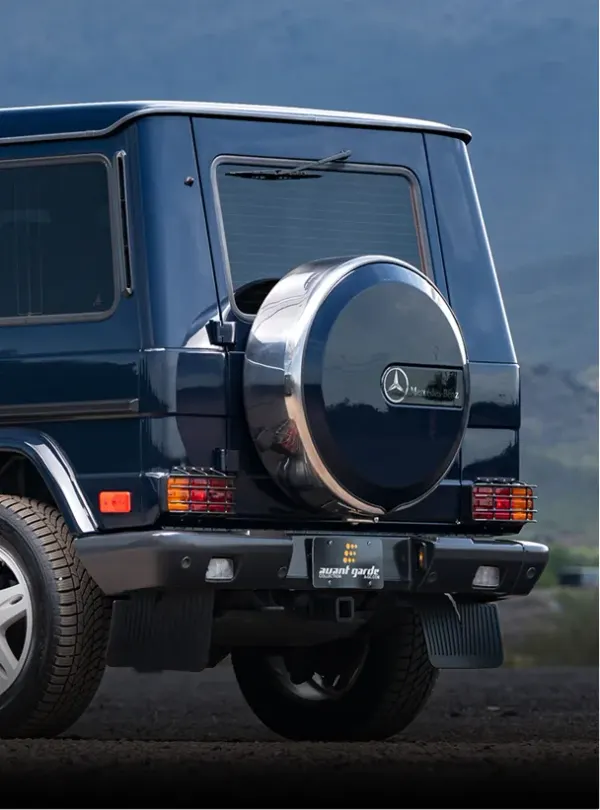
The photographs support much of this. The black 21 inch wheels with red calipers are visible, the Night Package black exterior trim shows on the window surrounds, side strips and the bumper areas, and the carbon fibre trim on the interior grab handle and door panels can be seen. The widescreen digital displays, the blue ambient lighting and the turbine style air vents are all visible. The rear mounted spare wheel with its painted cover is shown on the tailgate, and the sheet diagram also draws the rear spare with no damage code on it.
The equipment box on the sheet (sunroof, original alloys, power steering, power windows, leather, TV, navigation and airbags) could not be read with confidence, because every label has an identical oval around it. Nothing from that box has been listed as fitted, and a sunroof, navigation, TV and ETC are not confirmed on the sheet. Air conditioning is recorded as AAC, which is automatic air conditioning.
Japanese Auction Report Translation
The auction sheet has been translated and checked by Autoselecta. This is what it says, section by section.
The sheet is numbered 84141 and sits in the imported car prime corner. The first registration is Reiwa 6 (2024), August. The model is the Mercedes-AMG G-Class, grade G63 Launch Edition, engine size 4000 cc, chassis code 4AA-465250C, body type five door, drive 4WD. The auction grade is 5, the interior supplementary grade is A, and the inspection is valid until 29 August Reiwa 9 (2027). The odometer shows 16,343 km. The shift is marked CAT, which is automatic. Air conditioning is AAC. The exterior colour is original pearl, and the colour change box shows only an arrow with no different colour written. The colour number is 885. The fuel is petrol and the interior colour is black tone.
The new car service book with warranty booklet is marked as present. The import category is dealer, the steering is on the right, the recycling deposit is ¥22,060 and the seating capacity is five. The registration plate reads Shinagawa 369 chi 525, and the frame number is W1N4652502X008150. The dimensions are 469 cm long, 198 cm wide and 198 cm high.
Sales points, translated: one owner, first time offered at auction, non smoking car, Opalith White metallic paint, AMG Night Package, 21 inch alloy wheels, AMG carbon fibre interior, AMG Performance steering wheel, Burmester audio, front and rear seat heaters, front seat ventilation and relaxation function, AMG red brake calipers.
Points to note, translated: front cup holder with heating and cooling function, head up display, and dealer inspection records present for August Reiwa 7 (2025) and August Reiwa 8 (2026). The sheet also says that the service book, warranty booklet, owner's manual and spare key are marked as being sent on separately after the sale. In plain terms, these items are not described as arriving with the car at the auction, and a spare key is not confirmed to be with the car.
Inspector's report, translated: small scratches in the cabin, scratches on the side steps, and wheels scratched and gouged, meaning kerbed. The inspector reports no engine, gearbox, oil leak, coolant, warning light, air conditioning, electrical, suspension, steering, brake or exhaust faults. No rust, accident repair, replaced panels or smoke or odour issues are written either. Nothing mechanical is mentioned on the sheet, so this report does not claim anything about mechanical condition beyond the grade and the dealer records.
Other writing: the transfer documents expiry date is left blank, and the usage history box, which is only filled in when a car has not been in private use, is blank.
Damage Diagram and Body Condition
The diagram carries only two markings, and both are minor. At the front bumper area, at the top of the drawing, the sheet marks stone chips. This is the usual wear from motorway driving and it sits on the leading edge of the car, where small chips are very common even on cars that have been well kept. At the rear bumper area, at the bottom of the drawing, the sheet marks A1, which is a small scratch. The rear spare wheel is drawn on the diagram with no damage code marked on it.
No repair marks, panel waves, dents, replaced panels, repainting, rust, corrosion or glass cracks are shown on the diagram. That fits the exterior grade of 5. In the photographs the white paint looks clean and even, and the black trim and wheels look tidy, though the photographs are small and are not a substitute for the sheet. The wheel damage, which the inspector describes as scratched and gouged, is not drawn on the diagram but is listed in the inspector's report, and the side step scratches are in the same place. Neither is clearly visible in the photographs provided.
Overall this is a close to new, usable enthusiast condition car, nearer to collector grade for age than a typical used car. It has light use marks and nothing more is written, but the kerbed wheels and the side step marks should be priced in. Refurbishing a set of 21 inch wheels is a normal ownership cost.
Interior Condition
The interior grade is A, the top interior grade, and the inspector records only small scratches in the cabin. The sheet gives no smoke or odour comment, and the sales points describe it as a non smoking car. The interior colour is black tone.
The photographs show a dark cabin with quilted, perforated leather seats with light contrast stitching, carbon fibre trim on the dashboard grab handle and door panels, and an AMG Performance steering wheel with a flat bottom. The wide digital display, the central touchpad, the turbine style vents and the blue ambient lighting are all visible. The rear bench in the sixth photograph looks very clean, with no visible creases or marks on the cushion, though the angle is limited. The mileage display cannot be read in the photographs, so the sheet figure of 16,343 km is the one to use.
The front seats are listed as heated and ventilated with a relaxation function, and the rear seats as heated. These are sheet statements, and nothing has been tested by us. Headlining condition and boot condition are not described on the sheet, and the cabin photographs do not show them.
Japanese Auction Grades Explained
Japanese auction grading is an independent inspection scale, and it is one of the main reasons buyers trust the system. An overall grade of 5 is the grade reserved for the very best cars, near new with only the lightest marks. The interior grade is shown separately as a letter, and A means the cabin is in the best condition on the scale. Grade 5 is rarer than the grade 4 and 4.5 cars that make up most good used stock.
A grade is a guide rather than a guarantee. It reflects what the inspector could see at the time and says little about mechanical wear. A high grade combined with a low odometer reading, a single owner and dealer service records is a very good place to begin, but the individual comments still matter, and in this case they are the scratches, the side steps and the kerbed wheels.
Model History of the Mercedes-AMG G63
The G-Class began life in 1979 as the G-Wagen, a utility vehicle developed with Steyr Puch in Graz, Austria, where it is still built. For decades it was a rugged working vehicle, and the shape has changed remarkably little. AMG began tuning the G-Class in the early 2000s with the supercharged G55 AMG, and the original G63 AMG arrived in 2012 with a 5.5 litre twin turbo V8, joined by the G65 AMG with a twin turbo V12.
In 2018 Mercedes introduced a fully redeveloped G-Class, known internally as the W463A, which kept the upright design but brought a new frame, new suspension, new steering and a much improved cabin. The G63 of this generation uses the 4.0 litre twin turbo V8, hand built by AMG, and this is the engine in the car in this report. The Launch Edition badge appears in the grade on the sheet, but the sheet does not itemise what the package contains, so its exact contents are not confirmed here.
Why This Model Has Become Collectible
The honest answer is that a 2024 G63 is a modern performance vehicle rather than a classic, but the G-Class as a whole has a following unlike almost any other. It combines a design that has hardly changed in over forty years, hand assembly in Graz, a hand built AMG V8, and a reputation for strong demand in markets across the world. That mix has made the G63 one of the models most closely watched by buyers who follow the used market.
A nearly new, one owner, low mileage car from the Japanese dealer network has particular appeal. The sheet records the first auction appearance, regular dealer inspections, a non smoking history and very light wear. Japanese cars are known for staying close to original, and the combination of a high grade and a low odometer reading is increasingly hard to find. A right hand drive car also suits those markets that drive on the left, where official supply is limited.
This does not mean the car will rise in value, and nothing in this report should be read as a prediction. Prices for the G63 have moved in both directions with the wider market. Treat the car as something to buy because you want to drive it.
What To Look For When Buying This Model
For this car, start with the sheet. The service book, warranty booklet, owner's manual and spare key are marked as being sent separately after the sale, so ask Autoselecta to confirm what will reach you and when. The dealer inspection records for August 2025 and August 2026 are a good sign, but the paperwork itself is the proof. Check whether any manufacturer warranty can be honoured in your country, as Japanese warranties are not always transferable.
On the car itself, look closely at the 21 inch wheels, which the inspector describes as gouged, and price a refurbishment. Check the side steps, which are scratched, and the front bumper for stone chips. Large AMG tyres and carbon ceramic or high performance brakes are costly to replace, so check wear when the car arrives. Fuel consumption is heavy in a G63, which is part of the ownership cost, and insurance can be significant.
For an import, check the language and navigation on the infotainment system, as a Japanese market car may have Japanese maps, and radio frequencies and some connected services may differ. A right hand drive car will suit some markets and not others. Check the headlamp pattern, speedometer units and your own country's type approval rules for a car this young, as the rules for a nearly new vehicle can be stricter than for an older one.
Why Import This Car From Japan
Japan is one of the best places in the world to find a low mileage, well maintained luxury car. Cars are routinely serviced at the dealer, the shaken inspection culture keeps vehicles in good order, and the auction grading system gives buyers a trusted independent description. Cars like this one, with a single owner, a dealer service history and a grade 5, are the cars that the auctions are known for.
A G63 in right hand drive with this mileage and this condition is not easy to find elsewhere, particularly for buyers in right hand drive markets. Importing from Japan gives access to a car that would otherwise be difficult or very expensive to source locally.
Ultimate Guide For Japanese Imports
Buying at a Japanese auction follows a clear path. You choose the car and place a maximum bid through Autoselecta before the deadline. On the auction day the bidding is carried out on your behalf, and if the car is won, Autoselecta confirms the result and asks for payment. After that the car is prepared for export, the Japanese registration is cancelled, the export paperwork is completed and the car is shipped, usually by roll on roll off carrier or in a container.
On arrival you will need to deal with customs, duties and taxes, and any registration or compliance steps that apply in your country. These vary widely, and for a young car such as this one it is worth confirming the rules with your local authority before you bid. The live costs for this car, including the minimum bid and the estimated cost to your country, are shown in the price panel on this page.
All bids must be submitted before 9PM UK time the evening before auction.
Why Import Through Autoselecta
Autoselecta gives you direct access to Japanese auctions, with auction sheets translated and checked by Autoselecta so that you can read exactly what the inspector wrote. We help with vehicle sourcing, place your bids on your behalf, handle the export steps in Japan, arrange shipping and support you with the import process in your own country. Vehicle tracking is available where possible, and we stay in contact from the first enquiry to the arrival of the car. We do not promise unrealistic savings. What we offer is access, transparency and clear communication.
Browse This Week's Japanese Auctions
This G63 is one of many cars offered at Japanese auctions each week. Browse the current listings on Autoselecta to see other Mercedes-AMG models, other grade 4.5 and grade 5 cars and a wide range of performance, luxury and classic vehicles, each with a translated auction sheet where available.
Live Auction Search
If this is not quite the right car, use the live auction search to look for other G-Class models, other Mercedes-AMG vehicles or anything else you are searching for. You can filter by make, model, year, grade and mileage, and our team can search on your behalf if you tell us what you want.
Auction Caution
Auction cars are inspected before sale, but they are still used vehicles. An auction sheet is an independent guide to condition and is not a mechanical warranty. Even a nearly new car like this one may need servicing, maintenance or some refurbishment after purchase.
Please keep the important inspector points in mind. The inspector notes small scratches in the cabin, scratches on the side steps and kerbed, gouged wheels. The diagram shows stone chips at the front bumper area and an A1 small scratch at the rear bumper area. The service book, warranty booklet, owner's manual and spare key are marked as being sent on separately after the sale, so they are not confirmed to be with the car. The equipment box on the sheet could not be read with confidence, so sunroof, navigation, TV and ETC are not confirmed.


